


Good morning, Wimblers — January is finally over! I hope that everyone is enjoying their February so far.
This week, we’ve interviewed Alex Edmans, an award-winning academic and economist best known for his second book, May Contain Lies: How Stories, Statistics and Studies Exploit Our Biases - And What We Can Do About It. Edmans moved to Wimbledon in 2022 and wrote a large chunk of this book in Wimbledon Library — so we sat down with him to discuss how we, as locals, might find ourselves victims of our own biases and what we can do about it. Scroll down to hear his perspective.
We’ve also got your usual news snippets (including some very important news about Wimbledon and Mitcham’s police counters), some great recommendations for the weeks ahead and a beautiful property of the week.
As always, please do share The Wimble with your friends and family, and subscribe if you haven’t already. We’ve seen a lovely increase in subscribers over the past week, and we’re just a few hundred readers away from breaking that 10,000 mark!
Other than that, happy reading!
This week’s Wimble sponsor ⛳️

Fancy yourself as the next McIlroy? Or maybe you just want to take your frustrations out on the driving range. Either way, Caddi Club is the place for you. At Caddi, you can learn at your own pace. It doesn’t matter if you’re a golfing aficionado or a novice (like me); there’s room for everyone. And if you’re feeling thirsty or peckish, they also have an excellent selection of food and drinks.
News snippets 🗞
🔒 The Met Police counters in Wimbledon and Mitcham are set to close on Saturday 28 February. In a letter published on Friday 30 January, the Met confirmed that neither station will retain a public-facing counter. The closest 24/7 police counters will now be in Charing Cross and Lewisham. The possibility of closure has been on the cards for some time, and local residents have already made their opinions clear. Wimbledon MP Paul Kohler (and his fellow Merton Liberal Democrats) have campaigned to keep the police stations open, launching a petition that has already received thousands of signatures. Despite this, it appears the plan to close both counters is going ahead. London Now reports that these closures breach a previous commitment made by the Mayor of London that every London borough would retain at least one 24-hour police counter. Click here to read more.
📚 The headteacher of Hall School Wimbledon has pledged to lead the school into a new “era of excellence”, according to this interview with the Wimbledon Times. Jack Tyson — who was appointed permanent headteacher after a period as interim headteacher — said, “There is a magic here, created by the people, the ethos and the care that runs through every aspect of school life.” The school was founded in 1991 and is a non-selective independent day school for boys and girls aged 7–18. Click here to read more about Tyson’s plans.
💞 Wimbledon Quarter’s Valentine’s Day hamper competition is now live! One lucky winner will win a luxurious hamper filled with luxurious treats, romantic date-night (or mate-date!) experiences and exclusive gifts all from inside Wimbledon Quarter – with a total value of over £1,400. Included in the prize: The M&S Collection Hamper & selection of Valentine’s treats from M&S Simply Food, The Duchess Valentine’s bouquet from Blooms Wimbledon, a £100 voucher for 601 Queens Road, 2x 10-Day Experience Passes at STRONG Pilates, 50x Free Coffee Vouchers from Urban Baristas and much, much more. Click here to find out how to enter.
🚇 Have you ever wondered how the Northern line got its name? Well, wonder no more. A recent article in the Londonist outlines the process that took place in 1926. It also contains details of a suggested alternative: as the Bakerloo portmanteau of Baker Street and Waterloo had proved to be popular, some suggested the Northern line should follow suit. One person, responding to an article in the Express, argued that Balhamstead would be a fitting name: “The two districts honoured [Balham and Hampstead] are probably the most important at each end of the line, and the name is more informative than any combination of the names at the terminus stations." Click this link to read more.
Property of the week 🏡
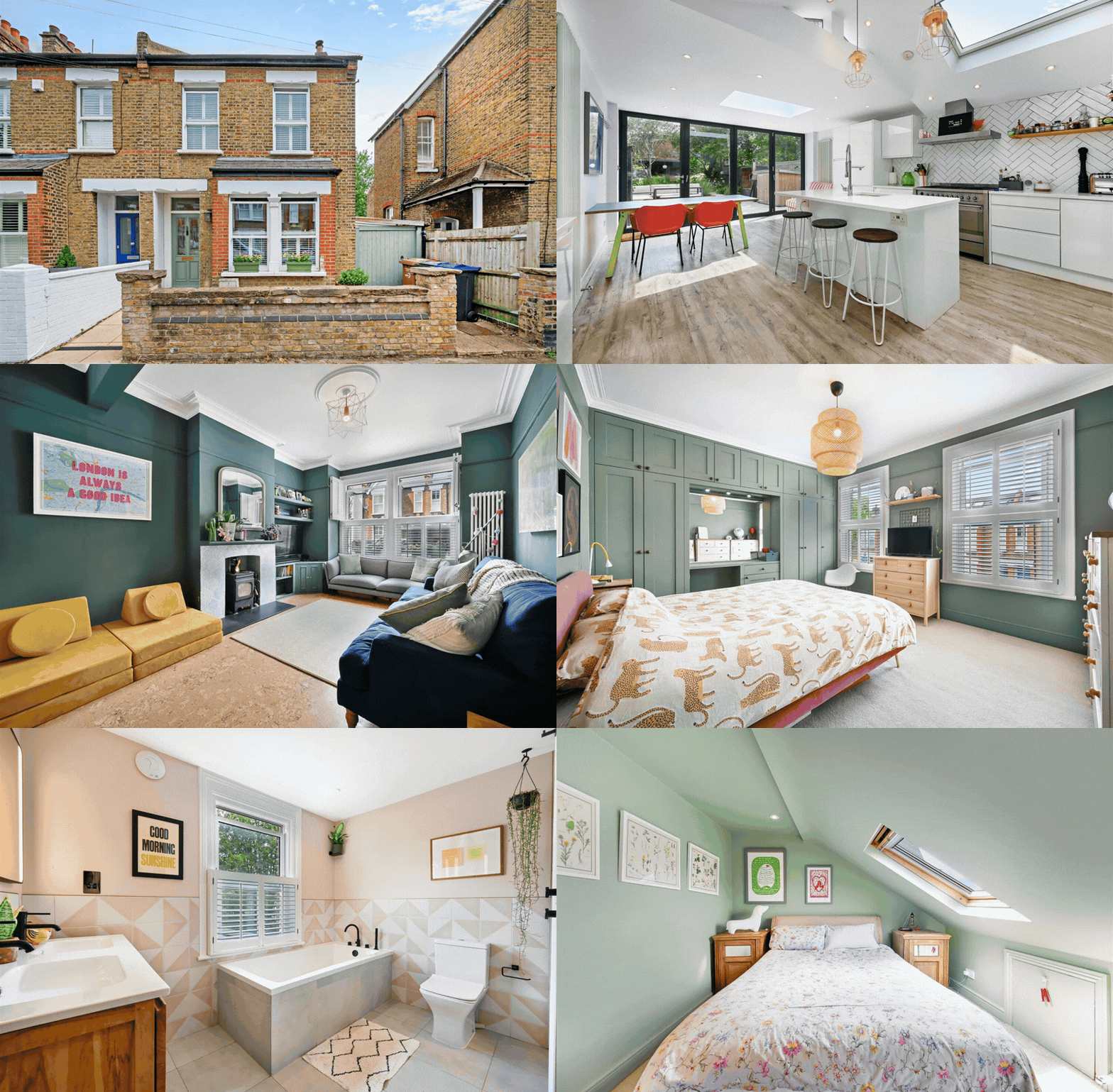
The sheer size of this garden is what does it for me; that and the charming log burner in the living room. Then again, that summer house isn’t too shabby either. Situated on a leafy street just a few minutes away from Colliers Wood tube station, this four-bedroom home is perfect for those wanting space in a quieter area with access to central London. What’s more, you’re only a stone’s throw from Merton Abbey Mills and the brilliant new restaurant Black Radish, which we featured a few weeks back. But how much? This modern home comes in at £1.25m. Not cheap, but hardly the most expensive property in SW19. Check out more photos here.
The Wimble’s to-do list 💘
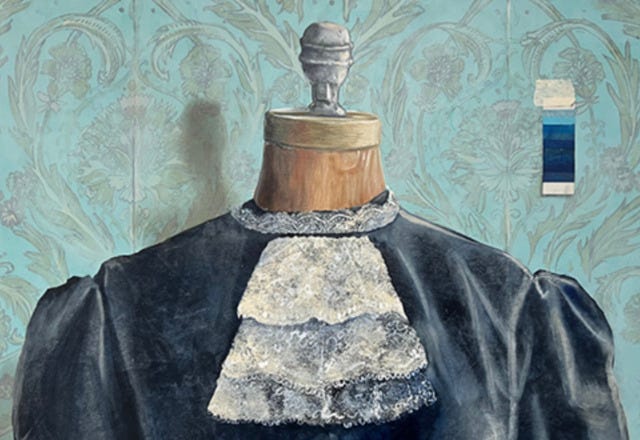
🏺 Exhibition: Objects of Enchantment: This exhibition encourages visitors to look closely at how the ordinary becomes the extraordinary. What happens when a simple object is lifted from daily life and placed on a museum plinth or turned into a painting? Local artist and artist in residence Alastair Gordon turns his eye to the museum’s collection, reinterpreting familiar objects and inviting viewers to reconsider what makes something worthy of attention, revealing how context, perception and imagination can turn the mundane into the marvellous. This event is entirely free and is open Fridays, Saturdays and Sundays from 2.30–5pm.
Where: Wimbledon Museum
When: Friday 6 February – Sunday 29 March
🏉 Six Nations: Are you wondering where to go to watch the Six Nations this year? Don’t worry, we’ve got you covered. Here’s a list of some of the best spots showing the games this year: The Alexandra, Wimbledon Quarter’s courtyard, Fire Stables, Rose & Crown, Caddi Club, The Old Frizzle, Crooked Billet, Dog & Fox and the Prince of Wales.
Where: See list
When: Thursday 5 February – Saturday 14 March
🍷 Prams & Pinot wine tasting: It’s been a while since we’ve featured the fan-favourite Prams & Pinot at Friarwood Wines. Learn about four seasonal wines accompanied by light nibbles in a relaxed and informal environment with plenty of pram space. Because why not start your week with a glass of wine? After all, you only live once. Tickets are £25 per person and can be booked here.
Where: Friarwood Wines
When: Monday 9 February, 1.30–3pm
🚨 Cuppa with a Coppa: This regular session is your chance to sit down with members of the local police force to ask questions and have your voice heard. The initiative is entirely free and no booking is required.
Where: Rose & Crown
When: Thursday 12 February, 10–10.45am
🐴 Wimbledon Village Stables Open Day: Once again, you have the chance to explore the yard, meet the horses and see how everything runs behind the scenes. It’s also a great chance to learn about membership options for the serious riders among us. No booking is required and the event is entirely free; just bring yourself!
Where: Wimbledon Village Stables
When: Saturday 14 February, 2–3pm
💋 Valentine’s Day at 601 Queens Road: We featured this last week, but it’s worth reminding our readers who have yet to make plans for Valentine’s Day. Spend the most romantic day of the year at 601 Queens Road enjoying a three-course menu with thoughtfully cooked dishes designed for sharing time. For £45 per person, choose from dishes such as Brixham crab tart and braised ox cheek vol-au-vent. Click here to view the menu and book your table.
Where: 601 Queens Road, Wimbledon
When: Saturday 14 February
📚 Waterstones Book Club: This month, head down to Waterstones on The Broadway to discuss February’s book, The Homemade God by Rachel Joyce. The story centres on four siblings who gather at their recently deceased father’s lakeside villa in Italy. They soon encounter their father’s secrets, their new stepmother and parts of themselves.
Where: Waterstones, The Broadway
When: Thursday 26 February, 7–8pm
‘A statement is not a fact’: In conversation with author and academic Alex Edmans 📈
Alex Edmans is a bestselling author, economist, academic, professor and, among other things, a Wimbledon local. Edmans is the author of two books — Grow the Pie (2020) and May Contain Lies (2024) — and has spoken at the World Economic Forum in Davos and testified in Parliament. He’s written for the Wall Street Journal, Financial Times and Harvard Business Review, and been interviewed by Bloomberg, BBC, ITV, Reuters and Sky News, among others. In short, he has quite the CV.
Edmans and I made contact around six months ago to discuss his previous work and his relationship to Wimbledon. We finally sat down in January to discuss his research on biases, data, business and how we can apply his theories on a local level. Here is how it went.

I think we ought to start at the beginning. You’ve had an incredible career so far: where did it all start?
I grew up in Berkshire and went to a school founded on Montessori principles. It was an education based on asking questions. They encouraged us to challenge everything. We didn’t wear uniforms, you called your teacher by their first name, and the overarching idea was to lead the answer out of a student rather than instil it in them. I then went to St Paul’s on a scholarship. I’d wake up at 5.30am every morning to catch the bus to Hammersmith Bridge and walk across to school. This was a very different education in comparison to my primary school, but I’m incredibly grateful for it. I was also the only boy in my year to study English and Economics at A-level (the other two were Maths and German), and that’s largely why I studied Economics and Management at Merton College, Oxford.
I think the two subjects complement one another: you have a theory, and that theory is not set in stone — we can both see the same data and one of us could think taxes should rise and the other could think taxes should fall. We can have a respectful conversation, and the two of us can walk away having learned something.
My first job was in investment banking in Canary Wharf, and whilst it was a good job, I felt the bandwidth of my contributions was limited. I then decided to become a professor, and I studied for my PhD at MIT Sloan before taking on a professorial position at Wharton. But I wanted to apply my research to the UK, so I moved back home in 2013, took on another position at London Business School and then wrote my first book in 2020. I moved to Wimbledon in 2022 and wrote the majority of my second book from here.
Your second book, May Contain Lies, is about misinformation. There is so much information (and misinformation) online these days — how do we navigate that locally?
People tend to reduce one big problem to a single statistic. Take crime in London, for example: we can take the big crime stats from each borough, but we often don’t consider population density or other contributing factors. I think it’s really important to be curious. We have to ask why a question is being asked and try to understand what we’re looking at. On the point of information overload, I think the issue is not so much about being online but about getting your information from unreliable sources. We tend to curate what we see online, which then feeds into this sense of confirmation bias.
May Contain Lies discusses your theory of the “Ladder of Misinference”. Can you explain what that is and how we can apply it locally?
Before I wrote May Contain Lies, I read many, many books on misinformation. They were all great. In fact, they were so good that they went on to list the 259 ways in which we can be misinformed. But the average person is not going to remember 259 ways of being misinformed when digesting information. I wanted to break misinformation down into four points, and I chose the ladder because when we start from a statement and draw a conclusion, we are essentially climbing a ladder. There’s also the famous expression of the “Ladder of Inference”, so it was a wordplay on that. So essentially I break down how an individual can be misled through four steps. Here’s how we might apply them in our community:
A statement is not a fact. In a local context, it might be said that a person was “mugged down the street by a person who is from a certain ethnic background or of a certain appearance”. We have to ask what the evidence is behind that statement. We have to make sure we check the facts.
A fact is not data: it may not be representative. Whilst this person may have been mugged by someone who is from a certain background, has the overall crime rate fallen? What percentage of crimes committed were committed by people who are from this background?
Data is not evidence: it may not be conclusive. Even if you do have large-scale evidence, is it correlation or causation? Does it happen to be that more people from this background live in the area for a specific reason? At the same time, has the crime rate gone up for a different reason?
Evidence is not proof: it may not be universal. Even if something is true in one particular case, it may not always be the case. Even if something is true in New York, it may not be true in London.
Your first book, Grow the Pie (a Financial Times book of the year), argues that businesses do not need to choose between making a profit and serving their community. How can we apply that idea in Wimbledon?
Making profit and serving one’s community are not mutually exclusive concepts. In the local sense, it’s best not to think about what you can get out of your business but how you can benefit your community — even if you don’t see a way of monetising that benefit. The best goals are often pursued indirectly. Profit can be a by-product of fulfilling a community purpose. Say, for instance, a local food business decides to give its excess produce away to the homeless at the end of every day; while it may not be economically profitable, the benefits can hit you in unexpected ways.
Let’s flip it around for a second and look at it from a consumer’s point of view: what is the value of shopping locally and supporting independent businesses?
I think it’s important to stress that not everyone should feel morally obliged to shop at local independent shops when there is a cost-of-living crisis. If that cost-of-living crisis is biting for someone, then they must do what is affordable for them in order to put food on the table. For those of us in a more privileged position, of course it’s important to support our local independent businesses. For instance, I buy from Wimbledon Books in the village. I could buy from Amazon, which is cheaper and more convenient, but that’s not the point. It’s about a 45-minute round trip to Wimbledon Books for me, but I take my kids, and it becomes an outing. I remember recently giving my son my card and letting him tap on the card reader to buy his sticker book. Every time he uses that sticker book, we remind him that he “bought it”. Sometimes we have to look past what is convenient and cheaper when supporting our community.
Alex Edmans’s new book, The Madness of Markets: How Smart Investors Make Crazy Decisions – And How To Exploit Them, will be published by Penguin Random House in September this year. Check out his website here and make sure to pick up a copy of his previous books at your local bookshop.
Question of the week 🔍
Last week, I asked you which famous director (from a list) once called Wimbledon home. The answer: Ridley Scott.
Q: Which of these celebrities was born in Wimbledon?
You’re up to date 👋
I hope you enjoyed this week’s edition and our in-depth interview with Alex Edmans. Please drop a comment below if you have any suggestions for upcoming events or ideas and everything in between. As always, drop me a line at zak@thewimble.com. Other than that, have a great rest of the week and we’ll see you next time!